— S.A.F.E. EMDR
Somatic and Attachment-Focused EMDR —
Healing trauma at its roots.
EMDR is one of the most thoroughly researched methods available for trauma recovery — and S.A.F.E. EMDR takes it deeper by integrating physical sensations and early attachment experiences for lasting, whole-person healing. Our brains have a natural way to recover from distress. Many times, traumatic experiences can be managed and resolved spontaneously. Other times, our fight, flight, or freeze response prevents distress from being processed without help.
WHAT IS EMDR?
A proven method for trauma recovery — without reliving every detail.
Eye Movement Desensitization and Reprocessing (EMDR) is one of the most thoroughly researched therapeutic methods available. It has been proven effective for PTSD, anxiety, depression, panic disorders, and a wide range of other distressing life experiences.
Unlike many therapies, EMDR does not require you to talk in detail about painful experiences or complete homework between sessions. Instead, it works by supporting the brain’s own natural healing process — helping it do what it was always designed to do, but could not complete on its own after trauma.
EMDR works by restoring communication between three key brain systems.
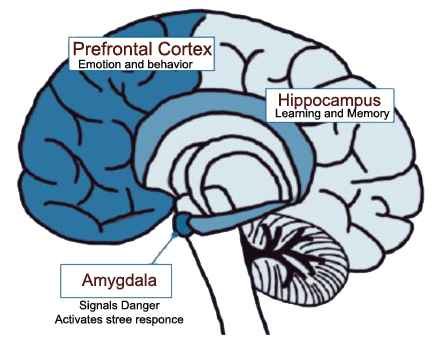
The amygdala — your threat detection center — signals danger and activates the stress response.
The hippocampus organizes memory in time, helping the brain understand that past events are not present threats.
The prefrontal cortex regulates behavior and emotion, helping you respond thoughtfully rather than react automatically. The result: traumatic memories are integrated rather than relived.
The experience becomes part of your history — not your present.
WHAT MAKES S.A.F.E. EMDR DIFFERENT?
Standard EMDR plus somatic awareness and attachment theory.
Standard EMDR is highly effective on its own. S.A.F.E. EMDR goes deeper by integrating two additional dimensions.
Somatic Awareness.
Trauma is stored not only in memory, but in the body and nervous system. We work with what the body is holding — not just what the mind remembers.
Attachment Theory.
Early relationship patterns shape how we experience distress throughout life. This approach incorporates those patterns as part of the healing process, not as obstacles to it.
A key principle is working within your Window of Tolerance — the zone in which you can engage with difficult material without becoming overwhelmed or shutting down. Your sense of safety in the process is not a luxury. It is the foundation on which everything else is built.
HOW EMDR AFFECTS THE BRAIN
The adaptive information processing model. Restoring the brain’s natural ability to heal.
EMDR is not just a technique — it is built on a specific theory of how the mind heals.
Developed by Dr. Francine Shapiro, the Adaptive Information Processing (AIP) model holds that the mind has an innate capacity to process and integrate experience — the same way the body heals a physical wound. Under ordinary circumstances, the brain metabolizes difficult events: they get filed away, learned from, and no longer carry an emotional charge.
Trauma disrupts this process. When an experience is too overwhelming — too sudden, too frightening, too isolating — the brain cannot complete its natural processing. The memory becomes stored in an unprocessed state, frozen with the original emotions, body sensations, and beliefs intact. This is why trauma doesn’t feel like a memory. It feels like now.
ADAPTIVE PROCESSING
When the brain is functioning well, it integrates experience automatically — extracting meaning and releasing distress over time.
BLOCKED PROCESSING
Trauma interrupts this. Overwhelming experiences get maladaptively stored, with their original emotional charge still active and ready to fire when triggered.
EMDR’S ROLE
EMDR doesn’t erase what happened. It helps the brain finally finish what it started — integrating the memory so it loses its grip.
In AIP terms, symptoms are not the problem — they are the signal. Anxiety, reactivity, shame, and disconnection are signs of unprocessed material still waiting to be metabolized. EMDR works by targeting that material directly.
Trauma disrupts the brain’s natural ability to process and store memories. When this happens, past experiences can feel urgently present — as if they are happening right now. Related sights, sounds, or feelings in everyday life trigger reactions that seem out of proportion because the brain is responding to an old threat as if it were a current one.
THE THREE PRONGS OF EMDR TREATMENT
Past, present, and future — all three are part of healing.
01 — Past. How are past events showing up in your life today? What memories are still carrying a charge?
The “Past” phase is the foundational step in EMDR’s three-pronged protocol — it’s where the actual reprocessing of the original memory happens.
What it targets. This phase identifies the specific past experiences that are the root source of current distress — the actual traumatic or disturbing memories, not their downstream effects. This could be a single distinct event (an accident, an assault) or a cluster of related experiences (years of a particular kind of relational harm) that share a common emotional theme.
Why it comes first. The logic of the sequence matters. Present-day triggers and future confidence are both, in a sense, downstream of the original memory — they’re shaped by how that memory is currently stored and how it still fires. Addressing the Present or Future phases before this one is a bit like treating symptoms without touching the source; the root memory would still have the same emotional charge and could keep generating new triggers even after the client re-stabilizes. That’s why Past is prong one.
What actually happens in session. The client brings the target memory to mind along with its associated image, negative belief (“I’m not safe,” “It was my fault”), emotion, and body sensation, while the therapist guides bilateral stimulation (eye movements, tapping, or tones). The aim isn’t to make the client re-narrate the story in detail — this is actually the exact promise the EMDR page’s “without reliving every detail” framing is built around — but to activate the brain’s natural adaptive processing so the memory gets stored differently: as something that happened, in the past, rather than something that still feels present-tense and threatening.
What “done” looks like. By the end of this phase, the client can bring the memory to mind and it feels like a memory — distant, resolved, no longer accompanied by the original intensity of emotion or the negative belief attached to it.
This phase is usually the deepest and often the longest of the three — it’s the “root cause” work, which is also why Denise’s site framing (targeting “the roots” of trauma) leans specifically on this phase as her core specialty, even though all three prongs are part of a complete treatment.
02 — Present. What current triggers are activating memories of the past? What situations or sensations set things off?.
In EMDR’s three-pronged protocol, the “Present” phase targets the current triggers — the situations, sensations, or reminders in someone’s everyday life right now that set off a distress response, even though the danger is long past.
Here’s the logic behind why this phase matters as its own distinct step:
Why it’s separate from the Past phase. Processing an old memory doesn’t automatically guarantee that the modern-day triggers connected to it stop firing. Someone can fully reprocess a car accident, for example, and still flinch every time they hear a specific engine sound or ride in the passenger seat. The Present phase specifically targets those live triggers — the current stimulus, not the original event — because the nervous system’s automatic reaction can persist independently of the original memory’s emotional charge.
What actually happens in session. The therapist and client identify specific present-day situations that still provoke a strong reaction — a tone of voice, a certain time of year, a physical sensation, a type of conflict — and use the same bilateral stimulation (eye movements, tapping, or tones) to process the client’s current response to that trigger, rather than the historical event itself.
The goal. By the end of this phase, a present-day trigger should provoke a more proportionate, manageable response — the nervous system stops treating an ordinary current moment like a replay of the original threat.
This is also where a lot of practical, day-to-day relief actually shows up for clients — the Past phase is often the deeper, harder work, but the Present phase is usually where someone notices “I got through that meeting without my heart racing” or “I didn’t shut down when he raised his voice.” It’s the bridge between historical processing and everyday functioning, which is also why it sits in the middle of the three-part sequence rather than being skipped.
03 — Future. How would you like to feel, react, and move through the world instead? What does healing look like for you?
The “Future” phase is the forward-looking piece of EMDR’s three-pronged protocol — it’s about building and rehearsing the response someone wants to have going forward, not just resolving what happened before.
Why it’s a distinct phase. Processing the Past phase clears out the old wound, and the Present phase calms the current triggers — but neither of those steps actually installs a new, positive template for how to handle similar situations in the future. Without this step, someone might stop being triggered but still lack a felt sense of confidence or competence going into a similar situation next time. The Future phase closes that gap.
What actually happens in session. The therapist has the client imagine a realistic future scenario that resembles the kind of situation that used to be difficult — a job interview, a conflict with a partner, a medical appointment — and then uses bilateral stimulation while the client rehearses handling it with the mindset, skills, or emotional state they want to have. This is sometimes called a “future template.”
The goal. Rather than just neutralizing distress, this phase is explicitly constructive — it’s rehearsing competence and calm in advance, so the nervous system has a positive, embodied reference point installed before the real situation happens, not just an absence of an old negative one.
Why it matters for the overall arc. This is really the phase that fulfills the promise in Denise’s “not just get by” positioning from the homepage — Past and Present are largely about removing distress, but Future is about actively building forward capacity. It’s the difference between “I’m no longer bothered by this” and “I actually feel ready for this.” That distinction is worth this site emphasizing more clearly in the copy, since it’s a genuine differentiator from therapy that only aims at symptom reduction.
Who can benefit from EMDR?
EMDR is effective for adults of all ages. I use it to address a wide range of challenges, including:
To learn more about EMDR, visit the EMDR International Association (EMDRIA) website https://www.emdria.org/about-emdr-therapy/experiencing-emdr-therapy/
GET STARTED
Ready to take the first step?
A free 15-minute consultation is a no-pressure chance for us to meet, connect, and see if we are a good fit.
EMDR doesn’t erase what happened.
It helps the brain finally finish what it started


Privacy policy · Notice of privacy practices · Good faith estimate · Verify my license #C6772(Oregon BLPCT)
If you are experiencing a mental health emergency, please call 911 or the 988 Suicide and Crisis Lifeline.
This website is for informational purposes only and does not constitute medical or psychological advice.© 2025 Denise A. Lucas, LPC · All rights reserved.